
DC to DC chargers
- Paul Scherek
-

- Offline
- Posts: 640
Outback Jack wrote: If you have the dollars I wouldnt bother with AGM batteries. Go with Lithuim.
The Redarc will not be able to charge them, but a Sterling DC DC charger is switchable to suit battery.
Interesting, OBJ, I have been trying to find out what charging regime is required for Lithiums, can you help out please? I saw one suggestion that the lithiums needed 14.5 volts constant voltage to charge and 13.7 volts to float. Is this correct? The Redarc can be set to 14.5, 14.9 and 15.3 volts to charge, but only 13.3 in float.
Deano, the Redarc does not automatically switch between alternator and solar, which is a bit of a pain. I use a relay to switch between the two automatically.
Please Log in or Create an account to join the conversation.
- Outback Jack
-

- Offline
- Posts: 1358
I am still green with it all.
I do know they need a particular charger. A Redarc will kill a Lithuim Battery.
Perhaps it is around 14.5, you do need to have a low voltage disconnect.
The Sterling Dc Dc charger has the right setting and you can put solar input on it as well, it goes on the same input as the alternator, which is 130 amp input. No relay etc required.
Redarc Failure about half way down
Please Log in or Create an account to join the conversation.
- Kav1050
-

- Offline
Some feed back and answers to questions:
I had to move our next trip dates forward and now only have 2 weekends to get things ready and pack and I have a bit of a list to get through
.Seeing that you are really wanting good performance on the solar side and unless you are absolutely committed to the CTek I suggest you reconsider
I already have the CTEK and the Battery's so ill have to stick with them. I do however have a spare 40A solar regulator but it is not MPPT. Might take it as a spare and if I think im not copeing with power I can install it and see what happens.
I only put it in there so I could isolate the other batteries and concentrate the charge into the spare OKA battery as I assumed it would take more in quickly then I could feed it back into the other system with the engine off. Do you see my Logic or am I Out thereIs your relay intended to supply additional power from the Oka battery (note CTEK is only a 20 A charger) or to allow solar only charging?
 - Your Right manual 100A switch best option here.
. Yes both are identical and brand new.You show batteries 1 and 2 connected in parallel. That's OK while charging but unless they are both the same type, age and condition
. yes they are resettable, much easier to fault find with.Re your R-PTC Fuses. Are you referring to manual or automatic resettable fuses?
. My intention here was only to monitor the constant draw on the fridges part of the circuit not the inverter. I need to look at this more because I really want to be able to monitor current draw so I can use the information to optimise my use in the future. I will go futher into this later with details see if we can find a solution.Note ammeter current shunts drop voltage too so you're better off just monitoring voltage rather than current and at full power, your inverter would take nearly 60 Amp.
Thanks for the info here, might be worth upgrading later. Let me know how you get on with the solar part please.Kav, I have the Australian made Redarc equivalent to the C-tek. www.redarc.com.au/products/product/40ain...low-voltage-version/
. They look pretty awesome OBJ, unfortunately I don't have the dollars (Yet). I hope the price comes down or some of my shares go up so I can get me a coupleIf you have the dollars I wouldn't bother with AGM batteries. Go with Lithuim.

Again thanks for all the feed back, sorry if I missed some questions.
Ill keep you posted on the improvements and the setup
Regards
Kav
OKA 423 Shane and Lisa
Please Log in or Create an account to join the conversation.
- Kav1050
-
- Offline
FL-2/0.5 200A 75mV
Details on Combination Meter (Volts/Amps)
UP5135A V/A DC200V / 200A
OKA 423 Shane and Lisa
Please Log in or Create an account to join the conversation.
- PeteFox
-

- Offline
Dean and Kaye Howells wrote: A question here, do these multi input (alternator and solar) units simply disconnect the solar panel output from the battery when the alternator is running or do they manage both inputs in tandem ?
Deano
Dean
The CTek in 266 doesn't appear to charge with both solar and alternator at the same time. When the engine is stopped, the ammeter goes to zero for a minute or two until the unit picks up the solar input and then commenced to charge.
It's really a moot point though, because with a 20A charger, the alternator is nearly always going to be able to supply the unit's maximum current so the solar is not needed in any case.
OBJ
A Redarc won't kill Lithium batteries, unless it is the ONLY charger hooked to the batteries. see below.
Lithium batteries require 14.6v bulk charge to get to 100% charge and 13.8v float (approx). The Redarc won't do this, so it wont bring the batteries to 100% charge. But there is no harm done in partially charging lithiums as long as they are bought to 100% charge on a regular basis, say once a fortnight. for this you will need a mains powered charger.
The reason for this is that in order to balance the cells properly (that is full charge in each cell), they need to be brought up to 14.6v. continual charging below 100% MAY cause the cells to become out of balance which in the very long term could severely reduce battery capacity. The exception to this is where sophisticated microprocessor controlled Battery Management is employed, this is not for the Oka though because the cost is prohibitive.
The type of battery on EBay is not what you need for an Oka. It is way overpriced and has no inbuilt monitoring or battery management. The seller says that you just hook up the exiting battery connections and go. Hmmmm, sounds like BS to me for a true deep cycle install.
I have had a 180AH lithium installation in my caravan for nearly 3 years now and it has been trouble free because it was installed properly in the first place. BMS, low voltage disconnect, programmable solar charger and programmable alternator charger, lithium mains charger. To shortcut this IMO would be inviting disaster.
Pete Fox OKA266 MultiCab
This email address is being protected from spambots. You need JavaScript enabled to view it.
www.byles.net/www.oka4wd.com/forum/membe...oka-266?limitstart=0
Please Log in or Create an account to join the conversation.
- Paul Scherek
-
- Offline
- Posts: 640
Just looking at the specs suggested by Pete, the Redarc looks like it should be okay unless the Lithium cells require super-accurate charging voltages. The Redarc can be set to charge at 14.5 volts, close to the suggsted 14.6 volts, but maybe not close enough - it is very difficult to get accurate info on Lithium cells. Or maybe the float of 13.3 is the problem, or maybe the point at which the Redarc goes from charge to float is the problem.
For AGM's a multi-stage charger typically goes from charge to float when the battery current draw drops to around 1 or 2 amps. It may be a totally different requirement for lithium cells. I will keep hunting for Lithium specs.
Cheers,
Paul
Please Log in or Create an account to join the conversation.
- Outback Jack
-
- Offline
- Posts: 1358
Ebay link was just a example, I think there are better buys out there and also as mentioned they do require a little more management to get the best out of them.
As time goes by they well be better understood and also come down in price.
Please Log in or Create an account to join the conversation.
- Kav1050
-
- Offline
The battery's can now be charged from the alternator and/or The 2x120 watt solar panels or a battery charger off mains
I have an amp meter that displays the amps going into the battery regardless of source
I have an amp meter that displays the amps being used regardless of what it is
Both meters go through a shunt and double as a volt meter. I have installed a on/off switch to turn the meters off to save on power drain when I'm not looking at them.
Connection from OKA is via 175amp Anderson plug mounted on the outside of the Travelander so it can be disconnected when taking the unit off the tray.
I can isolate the OKA or the solar input via the 100amp and 70 amp switches on top of the panel.
It's a start and well see how it performs over the next trip. I'll do some testing before we go too, run fridges and see how solar copes keeping up.
A few pics
Regards
Kav


OKA 423 Shane and Lisa
Please Log in or Create an account to join the conversation.
- Tony Lee
-

- Offline
- Posts: 513
Just a little trap for anyone thinking of using the combined ammeter/voltmeter units is that they usually need an isolated power supply. Easily done but requires buying a cheap DC-DC isolator as well.
Saw recently that some units can run on common power supplies so they have finally added the isolator into the meter circuitry to save us the trouble.
Tony
Please Log in or Create an account to join the conversation.
- dandjcr
-

- Offline
Tony Lee wrote: Just a little trap for anyone thinking of using the combined ammeter/voltmeter units is that they usually need an isolated power supply. Easily done but requires buying a cheap DC-DC isolator as well.
Or a 9v alkaline smoke alarm battery, should last a year or so. (Check the voltage requirement, 9v is common, some need 5v).
David and Janet Ribbans - Oka 148
Oka148 profile here.
Visit our technical and travel blogs: here.
Please Log in or Create an account to join the conversation.
- Kav1050
-
- Offline
Here is a link to the ebay site i got them from
Regards
Kav
OKA 423 Shane and Lisa
Please Log in or Create an account to join the conversation.
- Paul Scherek
-
- Offline
- Posts: 640
Kav1050 wrote:
Thanks for the info here, might be worth upgrading later. Let me know how you get on with the solar part please.Kav, I have the Australian made Redarc equivalent to the C-tek. www.redarc.com.au/products/product/40ain...low-voltage-version/
Regards
Kav
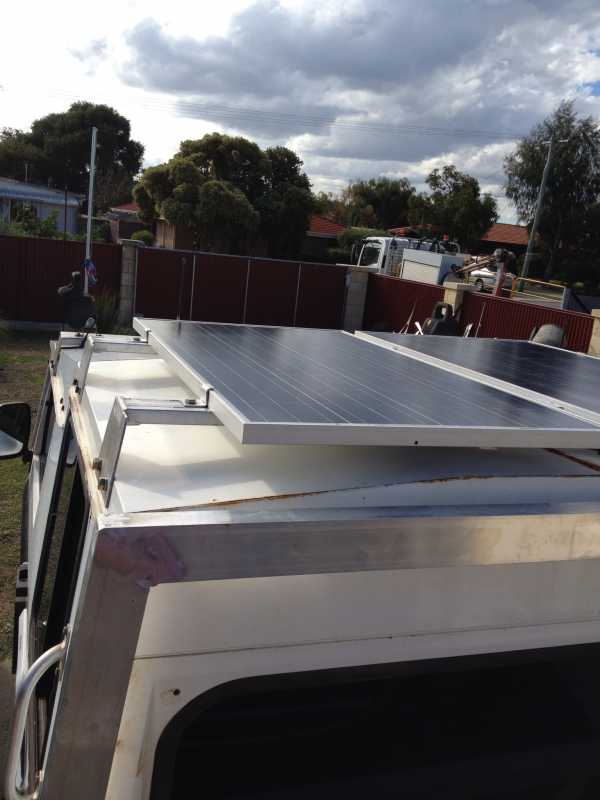
I tried the solar out yesterday. I have two semi-flexible panels on the roof, but I suspect only one is working. Under a 'moderate' sun, I was only pulling 3.7 amps from the panels. However, there was 4.2 amps going into the batteries, so at least the Redarc MPPT seems to be working very well. That works out to about 13% extra current into the batteries, well worth while.
Please Log in or Create an account to join the conversation.
- Kav1050
-
- Offline
I have also been running the lights for 4 hrs a night, all together there has been about 6 amp draw when the fridges are on and lights.
So far happy with that, mind you it's been fairly mild weather and there will be a difference in both the draw and input when up north.
I'll let you know how it goes in a week as we are off to coral bay in a few days.
Solar seem only to be putting in about 6 to 10 amps but I haven't been here during the day much to check it. I imagine the batteries are only taking what they need or the ctek is only giving the battery what needs. Higher when fridge compressors are running I imagine.
Regards
Kav
OKA 423 Shane and Lisa
Please Log in or Create an account to join the conversation.
- Dean and Kaye Howells
-

- Offline
- Posts: 533
Our load is really quite modest by comparison to others here. We have no 240 volt appliances but do have a 300 watt pure sine wave inverter just in case. Camera battery, mobile phone, TV and computer gear is all 12 volt and lighting will be LED all round. We have two Engels, one MF35 with Cool Zone attached for general food and drink with the Cool Zone being used as a crisper and a MF17 used as a freezer.
The intention is to use the 320 ah house battery to power the Engels and run the LED lighting from the existing internal light wiring from the main vehicle battery. The vehicle alternator will be replaced with a higher voltage/current Bosch which is more efficient and better suited to the Optimas characteristics. Charging of the house battery will be from roof mounted and/or portable solar panel(s) with the option of switching to the alternator if reqd.
Have checked out DC-DC chargers and dont think they're suitable for our application, hideously expensive to boot. What I reckon we want is a good solar reg that is capable of efficiently managing a flooded battery, MPPT by preference. It should be capable of handling appeox. 240 watts.
Having investigated just about every MPPT and PWM reg on eBay Australia this is not as simple as it might seem. Most offerings have suitable Bulk Charge voltages for a flooded lead acid battery which is the 'blunt instrument' of batterys and not overly critical but invariably have Float Voltages that are way too high, ie > 13.5 volts. Most have Low Voltage Cut Out settings of 10.5 - 11.1 volts which to me is way too low for battery longevity and easy management.
In the end I got it down to two contenders.
mppt-solar-charge-controller-regulator-max-20A-12v-only-with-LCD 200 watt
This one I liked because of its wide MPPT input range, comprehensive metering, low cost and conservative float voltages.
and this one
Votronic-Dual-Duo-MPPT-Solar-Regulator-Charge-Controller-with-LCD-Remote-Meter 240 watt
This one is really quite impressive and has some unique benefits. Its capable of handling a wide range of battery types, including Lithium, has reasonably conservative settings, can trickle charge the main battery, has good remote metering, external temp probe and costs just over $200.
For low voltage cut out I'll use Engels device which offers a more realistic 11.5 volt setting.
I'm unsure about running solar panels as nominally 24 volt or 12 volt. Carefully chosen panel(s) will place them at the high end of a regs MPPT range which should mean greater efficiency in low light and smaller cabling requirements but am unsure if this is the way to go or not.
Any comments ?
Deano.
Please Log in or Create an account to join the conversation.
- Paul Scherek
-
- Offline
- Posts: 640
The Votronics looks a good gadget, but the simple one from Taiwan should be fully adequate if it is as described. Taiwanese electronics in general is more likely to be 'as described' than Chinese mainland no-name products.
Cheers,
Paul
Please Log in or Create an account to join the conversation.
- dandjcr
-
- Offline
If your alternator "maxes out" at 13.8v, either it's regulator isn't working properly or it's got an internal fault. Any alternator should generate 14.5v or thereabouts when recharging a battery (like just after starting) and only drop to 13.8v after a few minutes or when fully charged. A new Bosch regulator is only around $40. If your alternator is an 85A model (and working) it should suffice for your needs but there are smart alternator regulators you can add later that can get the best out of a alternator if you need better performance (higher output for longer).
Votronics equipment looks good (made in Germany) but is expensive and probably not necessary. I would try the $85 model at 1/3rd the price. Note that it's only a 200W device which doesn't meet your 240W requirement. I wouldn't use 24v panels on this regulator, their maximum voltage would exceed it's specs. Cabling for solar panels isn't too onerous, we are only talking about 10-20A max so any fairly heavy cable would do (like headlight cable).
Sorry, but I agree with Paul about the large battery. It's heavy, might not prove reliable and presumably it's not an AGM? it's not good practise to mix different battery types having different charging requirements. A 100AH deep cycle battery is 1/2 the size and weight but if you did need more capacity, 2 would be more flexible than one larger one. For reference, we have a similar power budget to you (no heavy power devices but a 3way gas/electric fridge which takes almost no battery power). We have 200w of solar and 3 batteries, one starter and 2 100AH deep cycle (Supercharge Allrounders) and this has proved quite adequate. The solar panels keep all the batteries fully charged all year round when the Oka's not in use, which keeps them happy and I don't have to worry about charging them.
David and Janet Ribbans - Oka 148
Oka148 profile here.
Visit our technical and travel blogs: here.
Please Log in or Create an account to join the conversation.
- PeteFox
-
- Offline
I am a fan of 24v solar for 12v charging of batteries for a couple of reasons
- there is some extra charging time available during low light times (although at a reduced rate) that is not available in a 12v to12v system. No controller that I am aware of can increase the voltage above that which is coming from the panels, but with 24v wiring the voltage is inherently higher and low levels of charge are still available long after 12v systems stop charging.
- 24v wiring makes the installation less susceptible to voltage drop before the regulator which is where your longest cable runs (and therefore voltage drop potential) are most likely to be
I think the Votronics looks good. I think that the usefulness of the remote monitoring panel will far outstrip the pain of the extra money spent. It does no damage to have a higher panel output than the regulator's capacity, the capacity is limited by the regulator. You will only get full output in full sun anyway and 200w will be more than enough for your needs. Much more important will be the power availability on low light days where more solar panel area is better.
I agree with Dave and Paul about the battery. You haven't said where you intend to mount it, but you will have to make a cradle to hold it, a lot of work for a one-off. Way too much hydrogen generated for any sort of enclosed situation and there will be the inevitable corrosion from such a large wet battery.
I think that you will have all your eggs in one basket. Much better off IMO with two smaller dry batteries which will offer some redundancy if one fails.
An 11.5v cutoff is way too low for a 12v battery. A rule of thumb is don't discharge below 50% for reasonably long life. The table below shows the approx state of charge at various voltages.

At 11.5v you will be dangerously low and too many discharges to this level will damage your battery.
Pete Fox OKA266 MultiCab
This email address is being protected from spambots. You need JavaScript enabled to view it.
www.byles.net/www.oka4wd.com/forum/membe...oka-266?limitstart=0
Please Log in or Create an account to join the conversation.
- dandjcr
-
- Offline
Solar regulators I've seen for 12v/24v operation are usually spec'd for 12v to 12v OR 24v to 24v. Apart from off-grid controllers (which can handle up to 600v series connected panels), they don't normally suggest using 24v panels for charging a 12v battery system.
From a design perspective, an MPPT step down regulator should be capable of this configuration (and only an MPPT type, not a linear or PWM regulator) but it's worth checking the specs first.
But I'm happy to be proved wrong (again).
David and Janet Ribbans - Oka 148
Oka148 profile here.
Visit our technical and travel blogs: here.
Please Log in or Create an account to join the conversation.
- PeteFox
-
- Offline
I have a couple of these one in 266 and one at my farm! Both hooked up as 24v solar to 12v battery and this one works well. It is fully programmable for voltage output. I also have an Outback MPPT reg in another install that is a really good bit of gear.
I agree though, the regulator specs should state that it is suitable for this type of install as I understand that an over voltage on the input side can be terminal.
Pete Fox OKA266 MultiCab
This email address is being protected from spambots. You need JavaScript enabled to view it.
www.byles.net/www.oka4wd.com/forum/membe...oka-266?limitstart=0
Please Log in or Create an account to join the conversation.
- dandjcr
-
- Offline

David and Janet Ribbans - Oka 148
Oka148 profile here.
Visit our technical and travel blogs: here.
Please Log in or Create an account to join the conversation.